
A. J. Muste Memorial Lecture Series
This series celebrates the life and accomplishments of pacifist, labor leader, and Hope College alumnus Abraham Johannes Muste (1885–1967).
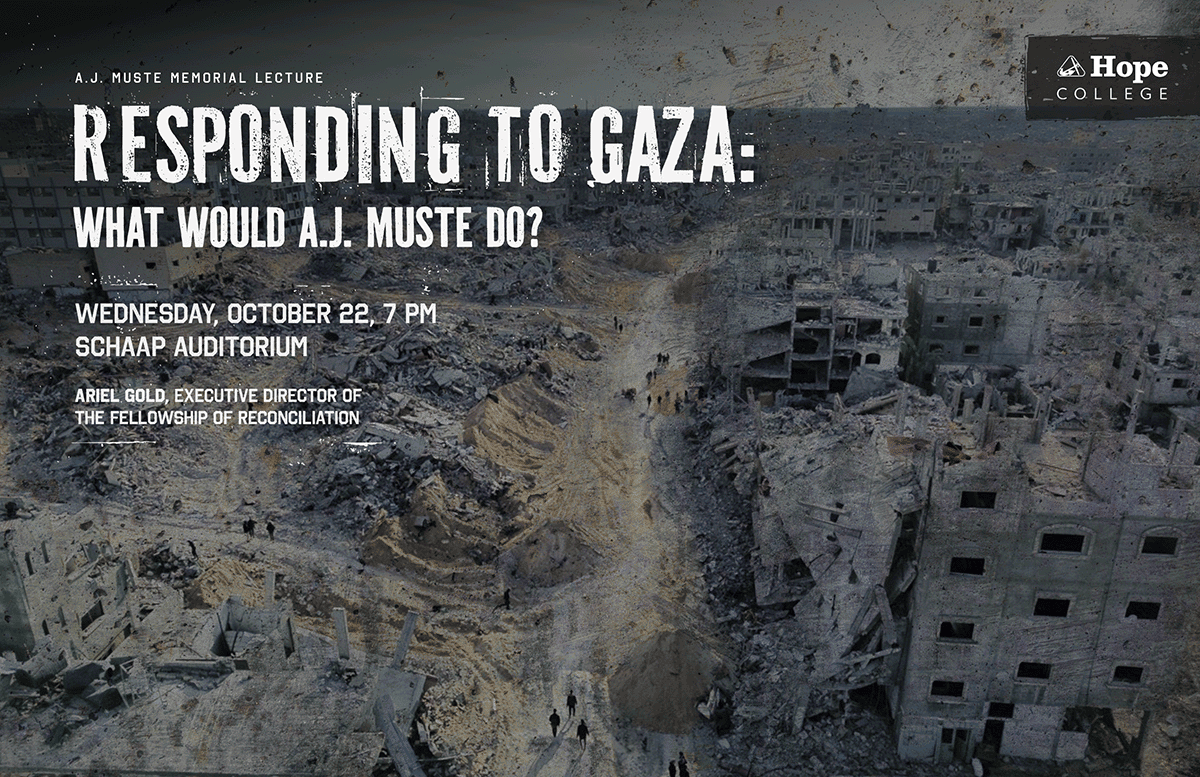 The 2025 A.J. Muste Memorial Lecture will be held on Wednesday, October 22, at 7 p.m.
in the Schaap Auditorium.
The 2025 A.J. Muste Memorial Lecture will be held on Wednesday, October 22, at 7 p.m.
in the Schaap Auditorium.
Our speaker will be Ariel Gold, speaking on the topic of “Responding to Gaza: What Would A.J. Muste Do?”
About her presentation, Gold says:
I am fascinated by Muste’s return to pacifism and the arguments he then makes about how wars and violence are inherently unable to bring about a higher stage of civilization. I will look at this argument of Muste’s from both the false calculations by Israel and Israel supporters that repression, walls, guns, bombs, occupation and siege can bring safety and the false assumption by some Palestinian leaders that Israelis only understand violence, that nonviolence has been tried, but failed, and is the only way to awaken the world to the suffering of Palestinians and bring about liberation is through rockets and massacres like October 7, 2023. I will discuss how, with violence, whether for the cause of Israeli security or Palestinian freedom, the ends never justify the means, what solutions are possible, and how to remain hopeful in this challenging time.
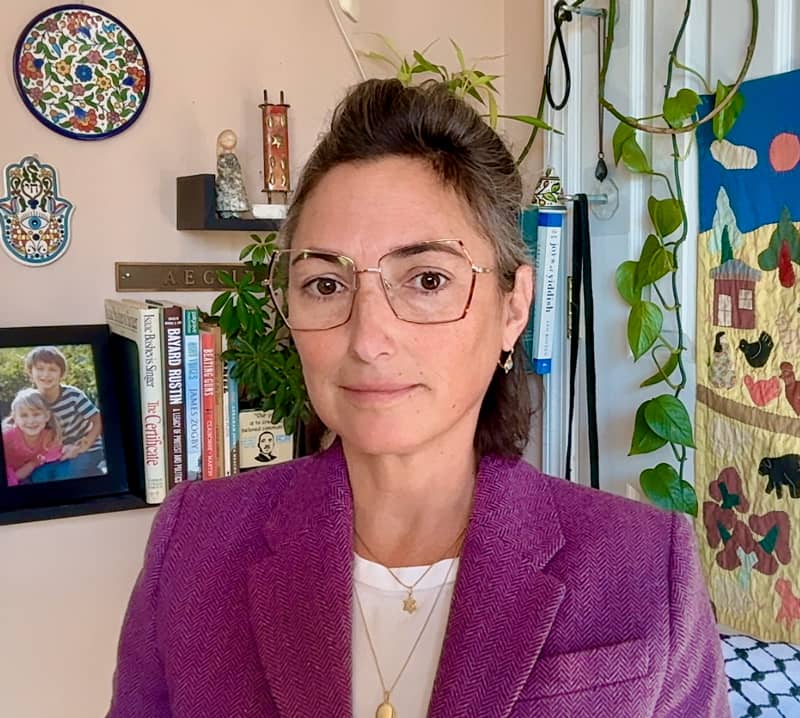 Ariel Gold has devoted her life to advocating for peace and justice, including the cause of
Palestinian rights. In 2018, Ariel was deported by Israel for her nonviolent work
for Palestinian rights. She led the feminist anti-war organization CODEPINK and is
currently executive director and UN representative of the interfaith organization
Fellowship of Reconciliation. She has contributed to the books Reclaiming Judaism from Zionism: Stories of Personal Transformation, edited by Carolyn Karcher, and Bayard Rustin: A Legacy of Protest and Politics, edited by Michael G. Long. She has been published in The Nation, Forward, Responsible Statecraft, Ms. Magazine and more.
Ariel Gold has devoted her life to advocating for peace and justice, including the cause of
Palestinian rights. In 2018, Ariel was deported by Israel for her nonviolent work
for Palestinian rights. She led the feminist anti-war organization CODEPINK and is
currently executive director and UN representative of the interfaith organization
Fellowship of Reconciliation. She has contributed to the books Reclaiming Judaism from Zionism: Stories of Personal Transformation, edited by Carolyn Karcher, and Bayard Rustin: A Legacy of Protest and Politics, edited by Michael G. Long. She has been published in The Nation, Forward, Responsible Statecraft, Ms. Magazine and more.
All are welcome!
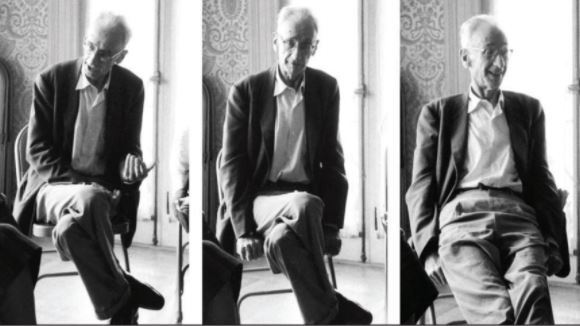 The A. J. Muste Memorial Lecture began in 1985 on the occasion of the hundreth anniversary
of the birth of A. J. Muste, a 1905 Hope graduate. Muste went on to become one of
the most well-known and influential peace activists in the United States, working
for many years as the executive director of the Fellowship of Reconciliation.
The A. J. Muste Memorial Lecture began in 1985 on the occasion of the hundreth anniversary
of the birth of A. J. Muste, a 1905 Hope graduate. Muste went on to become one of
the most well-known and influential peace activists in the United States, working
for many years as the executive director of the Fellowship of Reconciliation.
This lecture series seeks to explore issues that would have been of interest to Muste, who died in 1967, including topics related to labor, civil rights, and peace. Series speakers not only seek to commemorate the impact that Muste’s unwavering commitment to pacifism had on his contemporaries, such as Martin Luther King, Jr., but also to inspire current generations to strive for peaceful solutions to the world’s conflicts.


About a. j. muste
Abraham Johannes Muste, who immigrated from the Netherlands in 1891, enrolled in Hope College in 1902. Muste was a very active student while at Hope. He won the Michigan state oratorical contest, edited the Anchor, captained the Flying Dutchman basketball teams, which won two state of Michigan championships, and was valedictorian of his graduating class of 1905.
After graduating from Hope College, Muste went on to attend the New Brunswick Theological Seminary and was soon thereafter ordained in the Reformed Church in America. Muste was the ultimate pacifist and protested against every major war waged during his lifetime. In 1917, he resigned from the Central Congregational Church due to his pacifistic views, and the following year led the Lawrence, Massachusetts, textile workers strike. Among the many places where he has protested are famous landmarks like Red Square in Moscow, the United Nations, Times Square, and the White House. He was a seminal influence on the nonviolent philosophy of Martin Luther King, Jr. Muste has had an impact on major figures in the peace movement; many even called him the “American Gandhi.”
Interested in the A. J. Muste memorial Lecture Series?
Dr. Kathleen Verduin
Lubbers Hall-Room 316
126 East 10th Street
Holland, MI 49423-3516
616.395.7609